Data Governance Tools: Key Features and 8 Tools to Know in 2026
What Are Data Governance Tools?
Data governance tools are software platforms that help organizations manage the quality, integrity, security, and accessibility of their data assets. These tools provide frameworks for defining data ownership, creating policies, monitoring compliance, and maintaining consistent metadata across complex data environments.
With the explosion of data from multiple sources, data governance tools ensure that information is properly classified, cataloged, secured, and maintained according to organizational and regulatory requirements.
These solutions enable organizations to establish a centralized approach for data stewardship, collaboration, and accountability. By integrating functions such as data discovery, cataloging, quality checks, and lineage tracking, data governance tools streamline processes that were once manual and error-prone.
Benefits of Using Data Governance Tools
Implementing data governance tools brings tangible benefits across data management, security, and operational workflows. These tools help enforce consistent data standards, automate compliance monitoring, and reduce human errors in managing large datasets.
- Improved data quality and reliability: Automated validation rules, metadata management, and data lineage features ensure consistent, accurate, and complete data, reducing downstream errors in reporting and analytics.
- Enhanced data security and compliance: Governance tools offer access controls, encryption, and audit trails that help protect sensitive information and support compliance with regulations like GDPR, HIPAA, and CCPA.
- Increased operational efficiency: By automating manual processes such as data cataloging, classification, and policy enforcement, these tools reduce the time and resources required for managing data.
- Better decision-making: Trusted, high-quality data improves the reliability of business intelligence and analytics.
- Reduced risk of data breaches and compliance violations: Centralized monitoring and policy enforcement help detect vulnerabilities and prevent unauthorized access or data misuse.
Key Functions and Features of Data Governance Tools
Data Discovery and Cataloging
Data discovery and cataloging functions help organizations quickly identify, index, and classify their data assets across diverse sources, including databases, data lakes, and cloud platforms. These capabilities provide a holistic view into what data exists, where it’s stored, and how it relates to other assets. Modern data governance tools automate the discovery process using scanning algorithms, metadata extraction, and AI-driven pattern recognition to map both structured and unstructured datasets.
An effective catalog aids in organizing repositories and improves searchability and accessibility for end-users such as data analysts or business users. By tagging datasets with business-friendly terms and automatically generating lineage information, cataloging functions bridge the gap between technical and non-technical users.
Data Quality Management
Data quality management features are the backbone of trustworthy analytics in any organization. These functions automate the process of profiling, cleansing, standardizing, and enriching data sets. Through configurable rules and validation routines, data governance tools ensure that only high-quality, accurate data moves through business processes and reporting channels. This automation reduces manual data errors and frees up data teams to focus on more strategic tasks.
Continuous quality monitoring provides early detection of anomalies or quality issues, triggering remediation workflows or alerts. By integrating these features with feedback loops and performance dashboards, organizations can track data quality trends over time and proactively address recurring issues.
Policy Enforcement
Policy enforcement in data governance tools revolves around defining and executing data handling rules consistently across the organization. These tools allow administrators to set granular policies for data access, retention, sharing, and usage, ensuring that sensitive information is only available to authorized individuals under specific conditions. Automated enforcement mechanisms minimize human error and make policy application consistent, even in large and complex environments.
Enforcement functions often include approval workflows, exception handling, and automated logging of policy violations. This creates robust controls that help organizations adhere to both internal standards and external regulations. When compliance requirements change, policies can be updated centrally, and changes can cascade throughout the data ecosystem with minimal manual intervention.
Compliance Management
Compliance management features are essential for organizations facing stringent data privacy and protection regulations. These functions automate the mapping of regulatory requirements—such as GDPR, HIPAA, or industry-specific mandates—to technical controls and workflows. Data governance tools generate compliance checklists, track obligations, and create audit-ready documentation, making it easier to prove adherence during regulatory inspections.
In addition to ongoing monitoring for compliance, these tools offer proactive features like automated data subject request (DSR) handling, consent management, and incident notification workflows. By integrating these tasks within a unified platform, organizations reduce the risk of costly non-compliance penalties and avoid the manual overhead of preparing for audits.
Metadata Management
Metadata management is a foundational pillar of effective data governance, providing the necessary context for interpreting and utilizing data assets. Data governance tools use metadata repositories to store technical, business, and operational information about datasets, such as ownership, definitions, usage frequency, and data lineage. Comprehensive metadata management supports cataloging, classification, and data quality initiatives by making data context-rich and easier to understand.
Through the automation of metadata harvesting and updates, these tools ensure that all stakeholders—data stewards, analysts, business users—work from a consistent base of contextual understanding. Rich metadata enables advanced search functionality, semantic tagging, and automated data governance workflows.
Data Lineage Tracking
Data lineage tracking functions help organizations visualize and understand the complete lifecycle of their data, detailing how datasets move, transform, or aggregate as they travel through systems. Data governance tools map data flows from source to destination, including all intermediate processing steps. This transparency is critical for troubleshooting data issues, understanding the impact of changes, and ensuring compliance with regulatory auditing requirements.
Automated lineage tracking also supports root cause analysis by quickly surfacing where and how data anomalies originate. When paired with version control and change histories, these features help manage risks associated with data migrations, schema changes, or integration projects.
Data Security
Data security features within data governance tools focus on protecting data from unauthorized access, misuse, or breaches. These systems incorporate fine-grained access controls, encryption management, and user authentication protocols to safeguard sensitive and regulated information. By integrating with identity management systems and using role-based or attribute-based access frameworks, data governance tools ensure only authorized users can access specific datasets under defined circumstances.
Continuous monitoring and auditing features further enhance security by detecting unusual activity, policy violations, or potential threats. Centralized dashboards allow security teams to track incidents, generate compliance reports, and respond rapidly to emerging issues.
Notable Data Governance Tools
1. Collate®

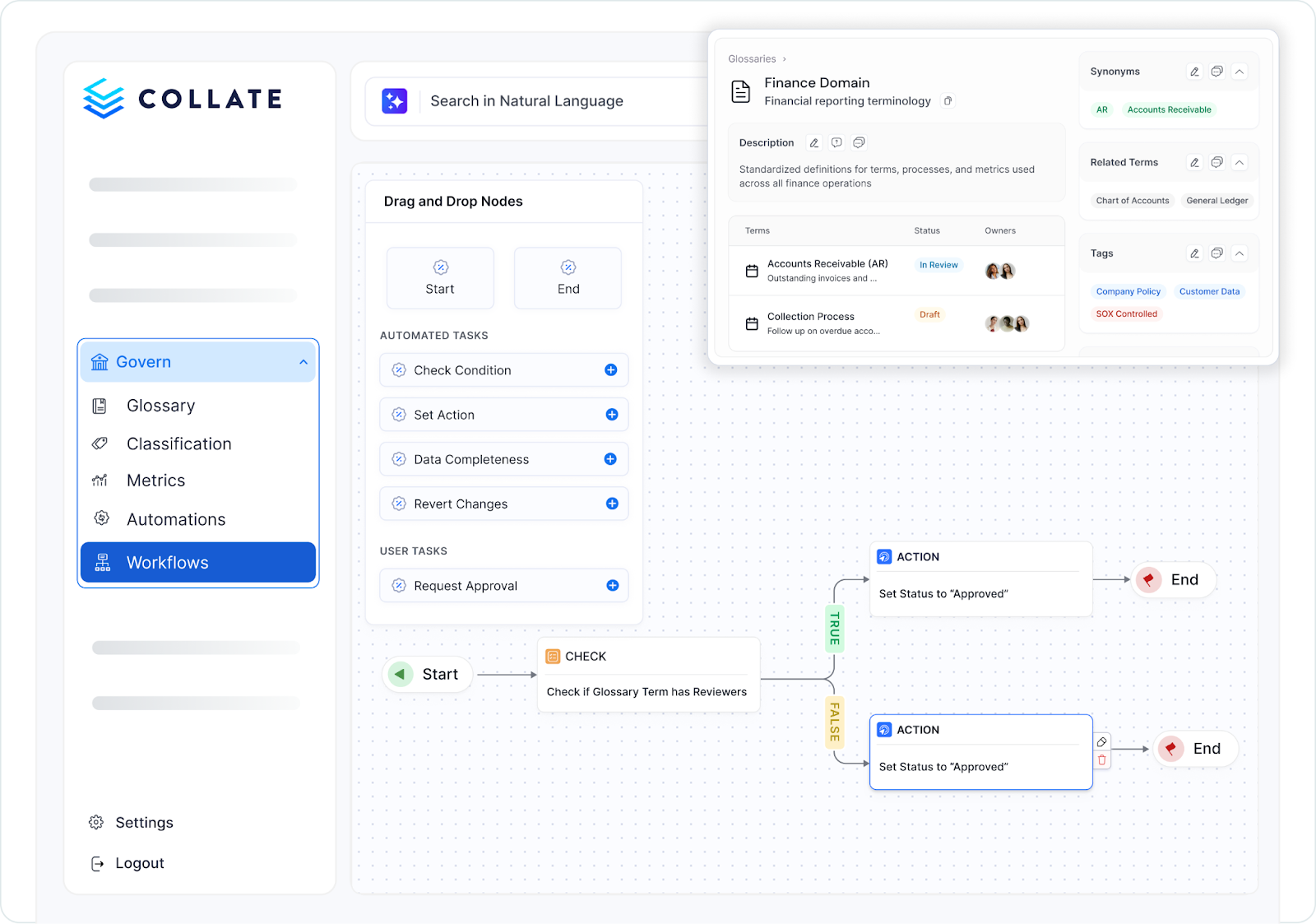
Collate is an AI-native platform built to automate data governance processes and improve data trustworthiness through AI-powered classification, custom governance workflows, and data product organization.
Key features include:
- AI-powered classification and metadata: Uses AI agents and conversational interfaces to tag PII, categorize data, and generate documentation for automated governance.
- Lineage-driven governance: Automatically maps relationships to enable policy enforcement, root-cause analysis, and impact analysis based on data flows.
- Fine-grained policy management and access controls: Role-based governance for access, usage, and ownership, with consistent policies across data assets, services, and users.
- Data contracts and data products: Enforceable agreements covering schema, semantics, quality, and SLAs, while organizing data into logical domains and products aligned with data mesh strategies.
- Custom governance workflows: Visual drag-and-drop builder for creating governance workflows with automated actions, custom conditions, and human-in-the-loop approvals.
2. Collibra Data Governance
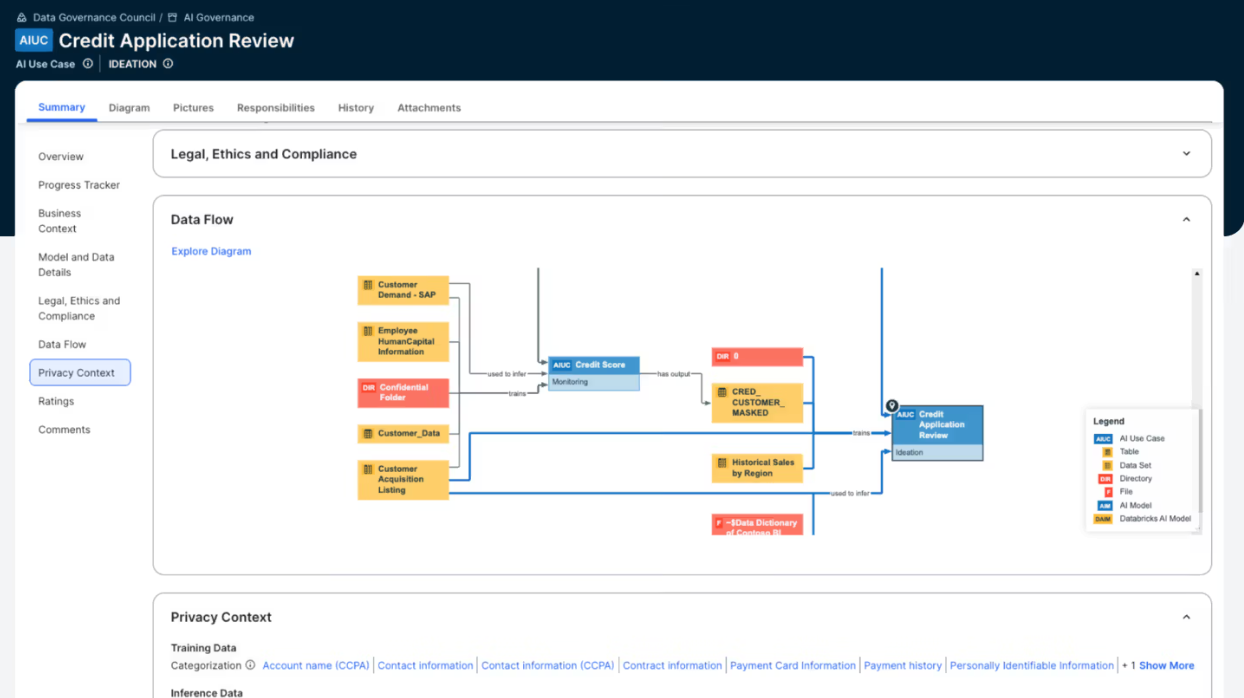
Collibra provides automated data governance with workflow-driven controls for business terminology, access, policies, and reference data management across the organization.
Key features include:
- Business glossary: Define shared terminology, rules, and regulations to improve consistent data usage and reduce ambiguity across teams and systems.
- Role-based access: Assign roles and responsibilities to protect data assets, ensuring the right users access appropriate datasets under defined conditions.
- Reference data management: Reconcile missing records and inconsistencies between systems to support more accurate reporting, analysis, and operational processes.
- Centralized policy management: Create, review, and update data policies centrally, with automated enforcement to maintain compliance and reduce privacy risk.
- Workflow automation: Design and automate governance workflows to operationalize processes, reduce manual effort, and improve consistency of policy application.
3. DataHub Data Governance
DataHub’s governance capabilities emphasize shift-left practices, AI-generated documentation, and structured workflows that standardize compliance, and certification across teams.
Key features include:
- Shift-left governance: Document datasets during development, establish lineage and purpose, and propagate tags and glossary terms back to source platforms.
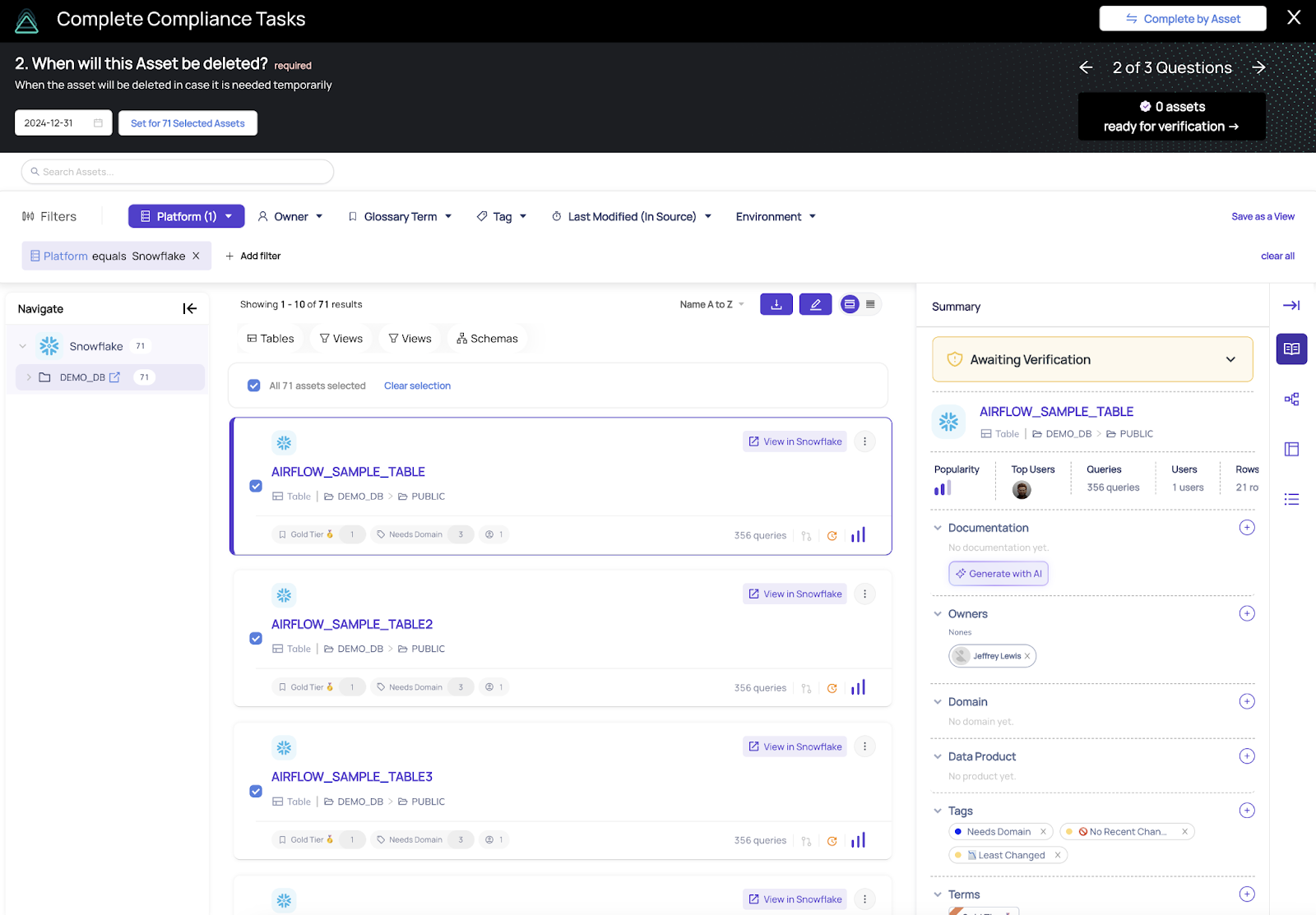
- Dynamic compliance forms: Define requirements, create annotation guidelines, and route tasks to appropriate users while tracking progress with targeted alerts.
- Contracts and attributes: Implement cross-team data contracts and publish reusable business attributes for consistent standards across dataset attributes.
- Certification workflows: Use guided asset certification with clear roles for data owners and stewards to formalize review and approval steps.
- Glossary and access control: Apply templated approvals for glossary updates and simplify access via centralized role definitions for consistent enforcement.
4. Alation Data Governance

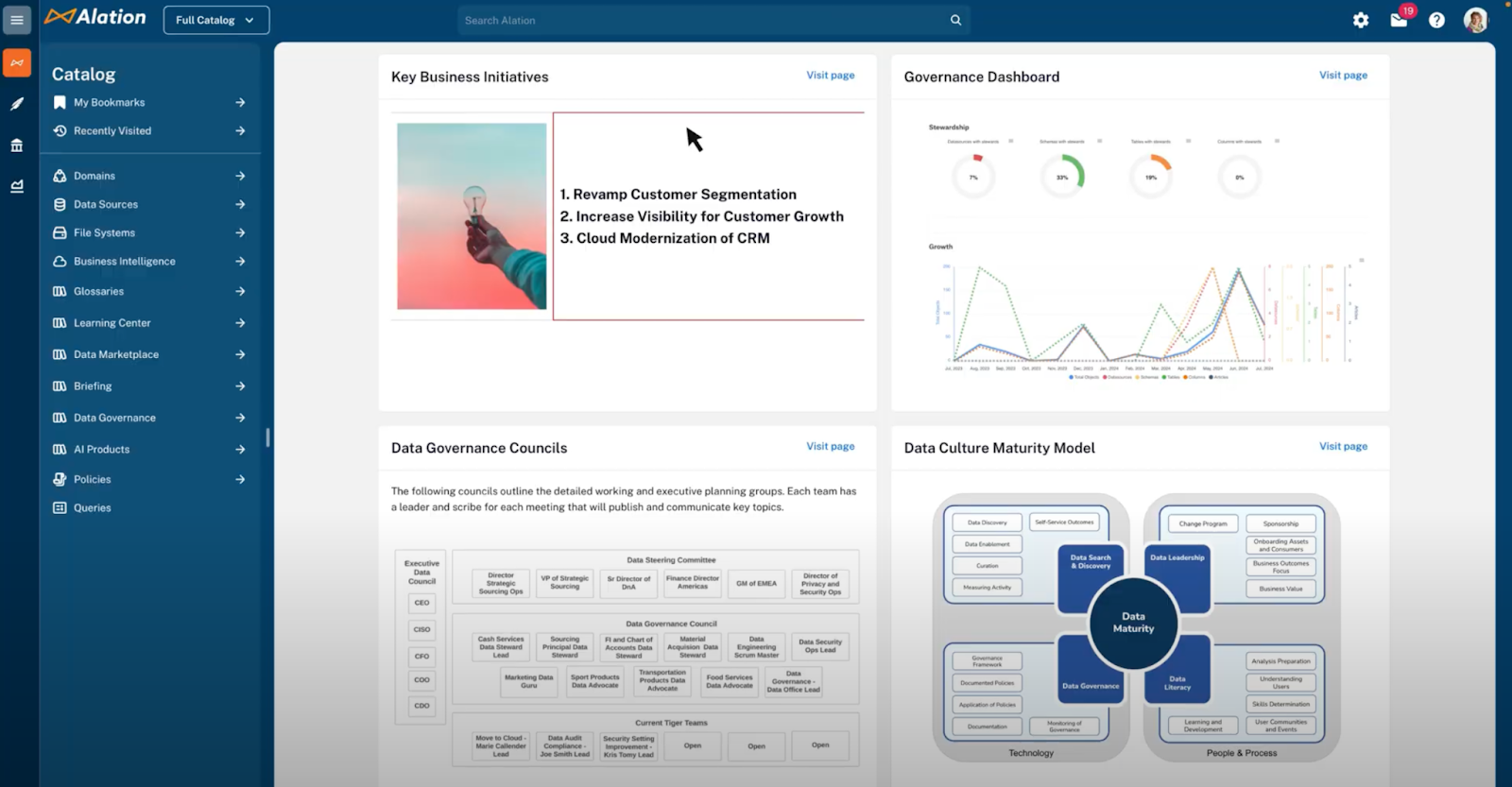
Alation’s data governance focuses on policy centralization, safe access, automated classification, and integrations that unify metadata, quality signals, and usage analytics.
Key features include:
- Search and discovery: Provide a search capability that guides users to trusted assets, supporting faster findability and consistent data usage at scale.
- End-to-end lineage: Show data’s journey from source to destination to understand dependencies, support audits, and enable impact and root cause analysis.
- AI-assisted curation: Generate suggested descriptions with AI to populate catalog metadata and accelerate documentation across assets and domains.
- Policy and workflow automation: Centralize policies in a Policy Center and automate governance tasks, including policy updates and renewals, with workflows.
- Quality and usage integration: Aggregate results from data quality tools and track data product usage to inform deprecation and adoption decisions.
5. Informatica Data Governance, Access and Privacy

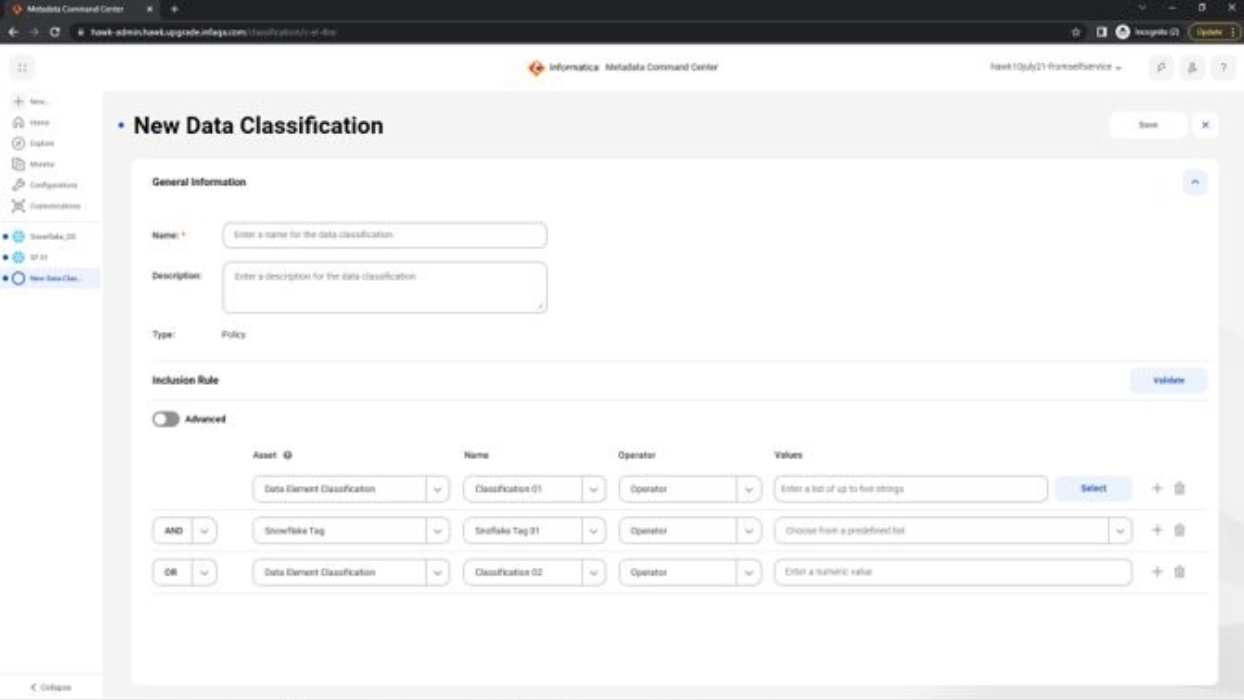
Informatica Data Governance, Access and Privacy delivers modern governance on the IDMC platform, combining cataloging, policy controls, quality, observability, and AI-driven automation.
Key features include:
- Visibility and lineage: Gain visibility into data sources and AI models to support explainable, responsible AI and trusted analytics across environments.
- Business context linking: Automatically link metadata with business context for a holistic view, improving transparency and shared understanding.
- Quality and observability: View profiling statistics and monitor scorecards from a single pane, integrating quality and observability signals for governance.
- Governed marketplace: Share data through a governed marketplace using policy-based access controls to manage safe, compliant data sharing.
- Active metadata automation: Use CLAIRE AI to automate governance processes, increase efficiency, and deliver governed data more quickly.
6. Atlan Data Governance
Atlan provides data and AI governance capabilities with discovery, policy management, automation via Playbooks, and developer tooling for integration and extensibility.
Key features include:
- Search and profiling: Search, discover, and profile assets across connected systems to improve understanding of data used in analytics and AI.
- Contracts and policies: Define data contracts and policies to govern access and management consistently across teams and platforms.
- Playbooks automation: Automate rule-based metadata updates at scale for bulk curation and consistent enrichment across large catalogs.
- Integrations and setup: Use prebuilt integrations and setup guides for Snowflake, Databricks, and Power BI to simplify onboarding.
- Developer ecosystem: Interact programmatically with APIs, client SDKs for Java and Python, and packages to extend platform functionality.
7. Secoda Data Governance
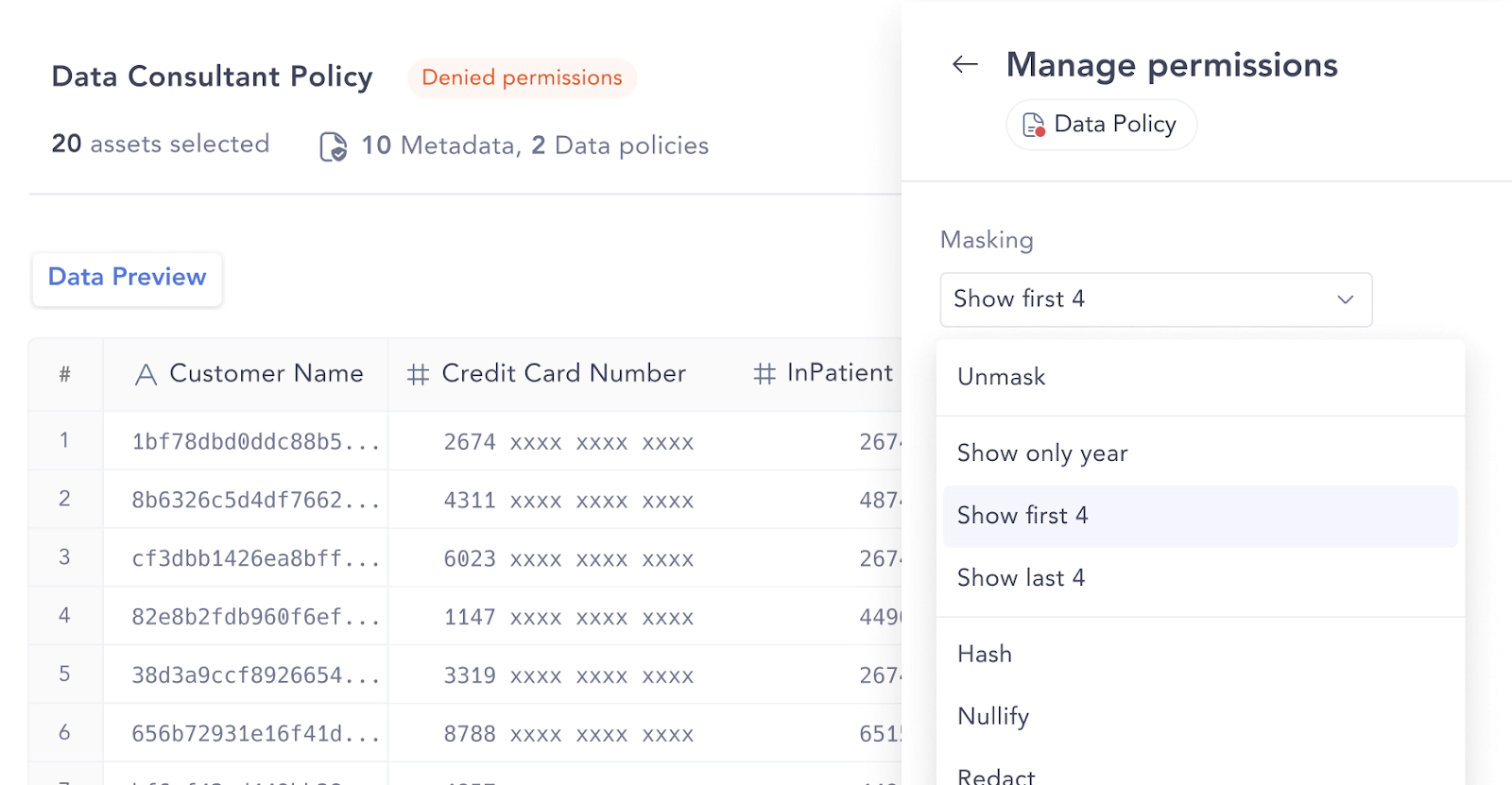
Secoda is a unified data governance platform emphasizing granular access controls, compliance policies, automated requests, and version-controlled change management.
Key features include:
- Granular RBAC controls: Manage secure access for internal and external users with fine-grained role-based controls across the data stack.
- Built-in compliance policies: Apply built-in GDPR and HIPAA policies, automatically enforce controls, and identify PII to mitigate unauthorized access risks.
- Custom roles: Tailor access for individuals and teams so each business unit sees only the data they require for their responsibilities.
- Access request workflows: Simplify access with automated approvals, customizable request forms, and audit trails for efficient, compliant operations.
- Version control integration: Integrate with Git to track and manage version history, supporting collaboration, integrity, and regulatory compliance.
8. Data.world (ServiceNow)

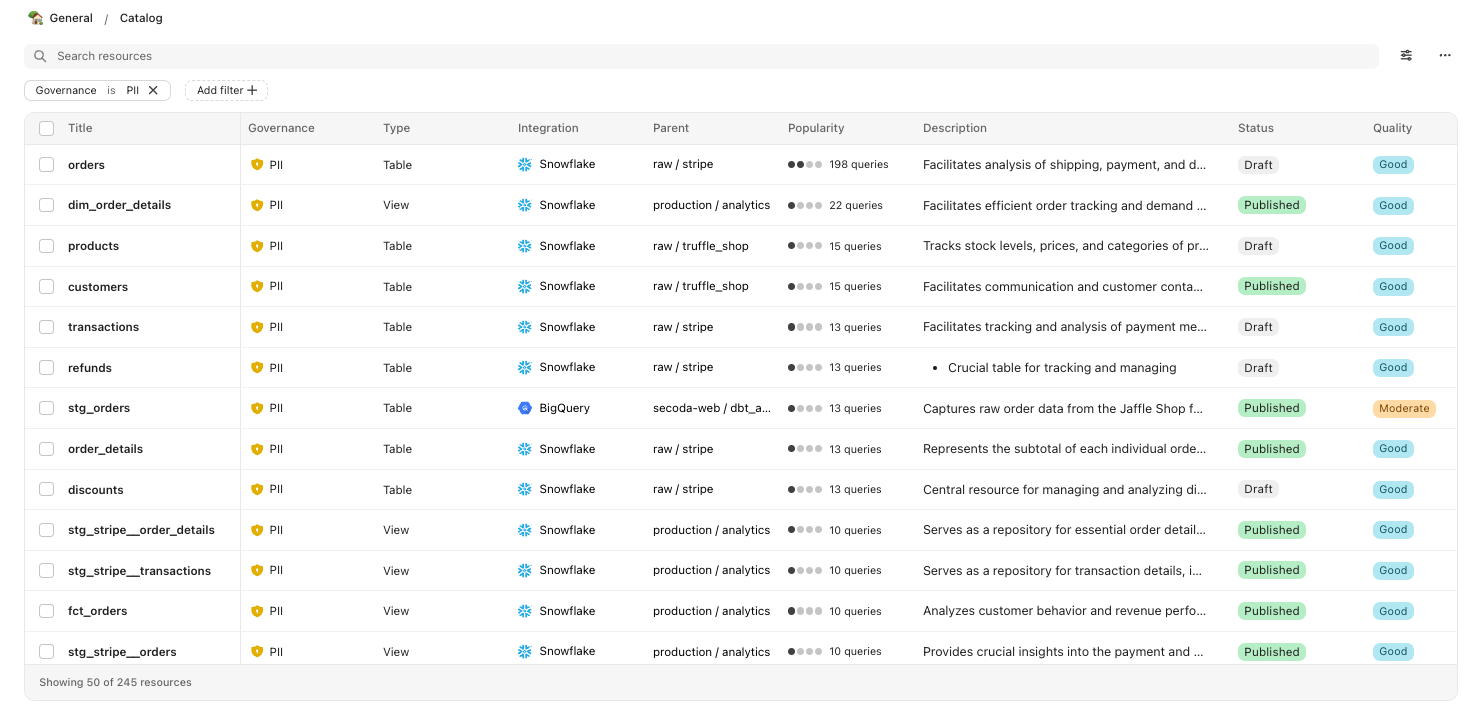
OData.world, now part of ServiceNow, is an enterprise data catalog built on a knowledge graph, offering search, governance automation, and a unified view.
Key features include:
- Enterprise search: Provide Google-like search that understands technical context and business meaning to improve data discovery and usability.
- Governance workflows: Automate governance with workflows that adapt to team processes, supporting policy application and ongoing compliance.
- Unified landscape: Connect sources to create a single view from data origin to insight, reducing silos across the data ecosystem.
- Knowledge graph foundation: Model relationships, context, and business logic to represent metadata as interconnected knowledge for governance tasks.
- AI context engine: Enable explainable, governed responses for LLM applications by grounding AI outputs in catalog context and metadata.
Related content: Read our guide to data governance platforms
Conclusion
Data governance tools centralize policies, access, quality signals, and metadata to standardize controls across complex environments. They automate documentation and workflows, align business and technical context, and provide visibility into lineage and usage. This combination supports consistent compliance, reduces operational risk, and improves the reliability of analytics and AI initiatives.
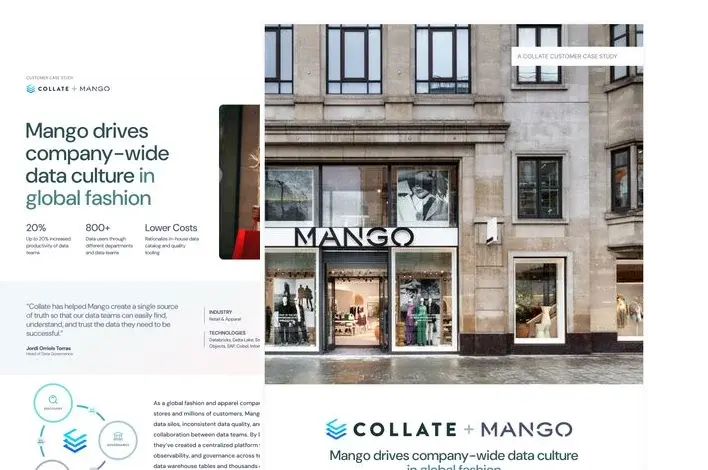
Fashion Retailer Mango’s Data Journey with Collate
Read the case study
Sign up to receive updates for Collate services, events, and products.
Share this article


Ready for trusted intelligence?
See how Collate helps teams work smarter with trusted data